
Shopping & Services
One year at OTTO: A mid-term review with division board member Boris Ewenstein
Dr Boris Ewenstein has been chairman of the management board and CEO of OTTO for just over a year. In this interview, he talks about his first impressions, customer-centricity and what European e-commerce can learn from its Chinese competitors, despite all the criticism levelled at them.


Boris, you joined OTTO just over a year ago. What surprised you the most? Which of your initial impressions have been confirmed, and which ones have you had to revise?
I expected a high level of expertise across all areas and touchpoints. This expectation has been confirmed, not least due to OTTO’s long history and transformation from a catalog to a platform business. The impression I had of the corporate culture has also been validated. My move to OTTO was about preserving core values such as appreciation, orientation, and care for employees while also guiding the company, together with my fellow board members, into the next phase of development. This includes increasing the pace and enhancing the drive for performance. I believe we can collectively improve in this area.
In what way?
One example is our culture of documentation, which is characterised by high standards of quality and completeness. Sometimes, however, there is no need for a comprehensive PowerPoint presentation, and issues can be tackled and resolved much more directly, quickly and efficiently – for example, with a short but precise Word memo. We’re working on that. I can already see how we are moving even more towards cross-functional working, supporting one another and working together towards our shared goal of generating real added value for our customers.
Main task? Creating an attractive product range for customers
This added value stems not least from the product range. As a hybrid platform, OTTO sells both its own products and ranges from marketplace partners. What are the challenges involved in striking a balance between these two pillars?
Our main task remains to create an attractive product range for our customers – across all product categories and sourcing channels. This is not always easy with a hybrid platform. We must ensure that we can offer the right products and brands with the right availability at the right prices. This requires conscious curation. We want relevant, high-quality partners, also to cover deliberate gaps that we cannot serve through our retail business with strategically chosen partner assortments.
Why is curation so important?
Completely open marketplaces, where virtually anyone can sell their goods, carry risks. If, for example, I offer items that are extremely cheap, I can expect them to have a high conversion rate – in other words, to sell well. The algorithms that control the search results make these items more visible as a result. And this is despite the fact that these are not always the products that contribute to long-term customer satisfaction. The result is that the platform’s quality erodes, and based on this experience, consumers have no compelling reason to shop at the store again. These so-called ‘downtrading’ effects must be managed on a hybrid platform. That is why we set very high standards for our partners. The range must be ‘just right’, not ‘just in case’. And yes, attractive introductory prices are also part of the package.
What about the scaling potential for OTTO amidst all this curation?
It’s worth taking a look at the overall German retail market, which, including food, is around 620 billion euros. Of that, 90 billion euros are generated online, resulting in a penetration rate of about 14.5 percent. In comparison, the UK stands at double that – 27 to 28 percent. In China, it’s at 40 percent. This alone presents opportunities to scale up to 180 billion euros based on that model. At OTTO, we generate approximately 8 percent of the total German volume of 90 billion euros with our revenue of 7 billion GMV in the fiscal year 2024/25. There is significant potential to capture market shares here.
Expansion of marketplace partners we would like to see on the platform
How do you plan to achieve this?
We want to inspire our customers and excite them through the interplay of brand, storytelling, and high-quality products. This is paired with exciting assortment-related services such as assembly or connection services for furniture and electrical appliances, or attractive financing options. This focus is paying off: our marketplace business alone grew by over 20 percent in net sales (GMV) in the past fiscal year. That’s where we’re continuing now. We have defined lists of marketplace partners that we absolutely want on the platform – also for new product areas we want to explore. This includes some curated Chinese partners, our "Pearls." I say this deliberately, as they are often misunderstood as being of inferior quality in public discourse. However, that is too simplistic. There are indeed Chinese partners who share our high-quality standards and can delight customers.
We maintain our standards of quality and sustainability
However, the Chinese competitors currently changing e-commerce are primarily known for cheap goods...
The success of these market players shows that there is a demand in this very low price segment. We also want to offer competitive prices, but without compromising our quality or sustainability standards. Instead, we aim to make this standard accessible across all product categories – such as in our furniture assortments or in semi-custom kitchens, which we can offer in collaboration with Küche & Co. at a very attractive price. A financing service can also enable customers to enter quality realms they might not even know are affordable.
When it comes to competition from the East, you are no longer just theorists: you recently visited China to get a firsthand look at the industry there. What impressed you?
The sheer pace of innovation. Take, for example, the mobile phone and network equipment manufacturer Xiaomi, which switched to electric mobility at short notice due to dwindling opportunities for international expansion. Within 18 months, it had designed a car and built the necessary factory with a production capacity of 20,000 units per month. This is typical of a country that filed over 1.6 million patents in 2023 alone, and demonstrates just how quickly it is able to respond to changes in the market.
It is worth drawing inspiration from their pace. At the same time, however, quality and aspects such as sustainability remain non-negotiable for us.
When we talk about China, the discussion often centres on regulation and a lack of standards – and this is a valid and important debate. However, these competitors will very quickly find ways to comply with the EU’s stringent regulations and the growing demands of consumer protection organisations – whilst maintaining their innovative drive. That is where we need to focus our attention. It is worth drawing inspiration from their pace. At the same time, however, quality and aspects such as sustainability remain non-negotiable for us. We operate within this tension.
Where else can we learn from China?
China is very good at blending entertainment and consumption. We come from a world where people traditionally find products via the search bar. In Chinese e-commerce, however, we are increasingly seeing developments that work exactly the other way round – that is, products that so to speak search for people. This works through entertainment, streaming and live video formats, or product offerings in news feeds that provide a personalised compilation of purchasing interests across different product ranges. We haven’t quite got there yet in the local market, and of course we also have much stricter data protection regulations. However, we see potential for OTTO with formats like our live shopping to rethink interaction. The next step is to see how we can connect this with an "Interest Graph," meaning individual, personal interests, to address customers even more individually and purposefully.
Internationalisation and agentic commerce
Boris, you’ve now completed your first 365 days. What will your second year at OTTO bring?
For me, the most important thing is that we further increase customer satisfaction so that they are happy to keep coming back to us and recommend us to others. We aim to achieve a great deal in this regard this year. There are many brands we still want to bring on board to expand our range in an attractive way. We want to further develop high-potential own-brand ranges such as Lascana and Hanseatic, and continue to promote and expand our truly first-class range of services. In our B2B business, our plans include establishing links with international partners. Through our Advertising Services, we aim to create an even more relevant shopping experience for our customers and help partners achieve their goals. Furthermore, we can help advertisers reach customers beyond our platform, thereby becoming a strong marketing partner.
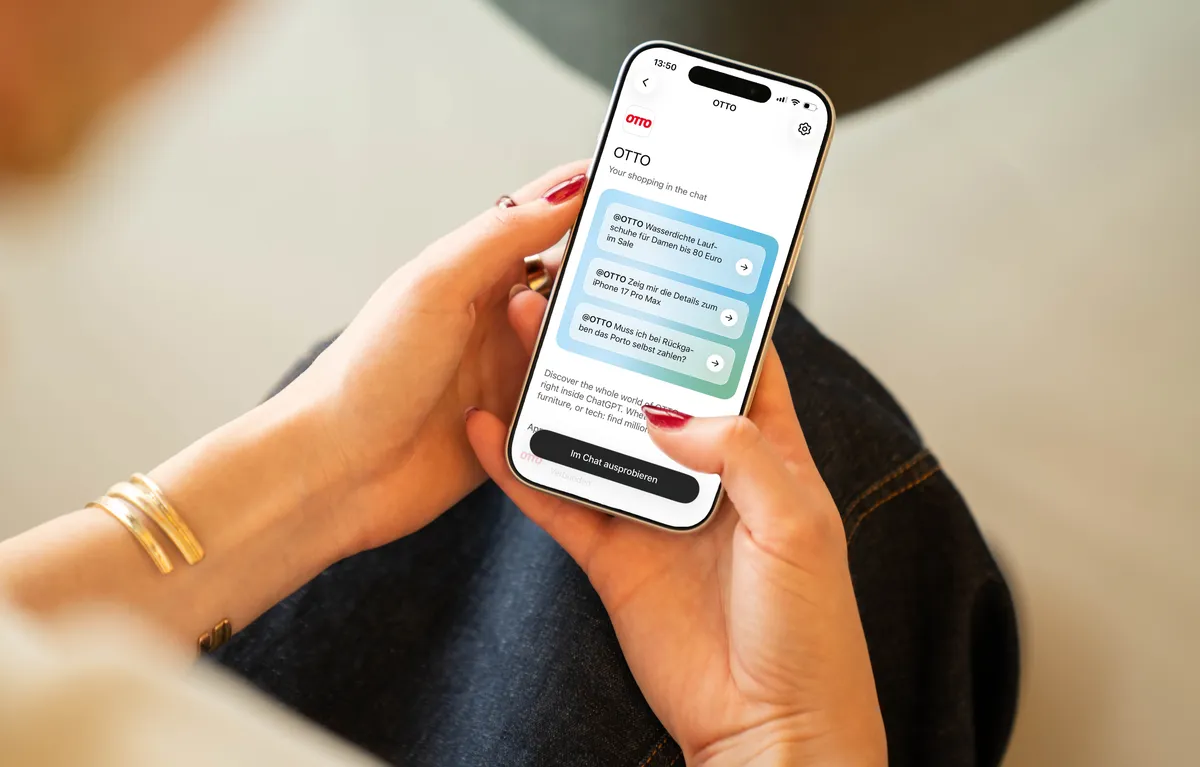
Last but not least, we see enormous potential in AI-powered product advice in-store. In the fourth quarter, we will launch a shopping assistant that helps customers find the product they’re looking for through dialogue, bringing traditional product advice into the digital space.
So there’s plenty to do – and I say that with great anticipation.
Thank you very much for the interview, Boris.