

Responsibility
Compostable Shipping bags: "More complex than thought"
Together with Hamburg-based start-up traceless, OTTO is developing a fully compostable mailing bag made entirely from plant-based materials. A new prototype has been completed and initial tests have shown promising results, but a large-scale live test has been postponed.
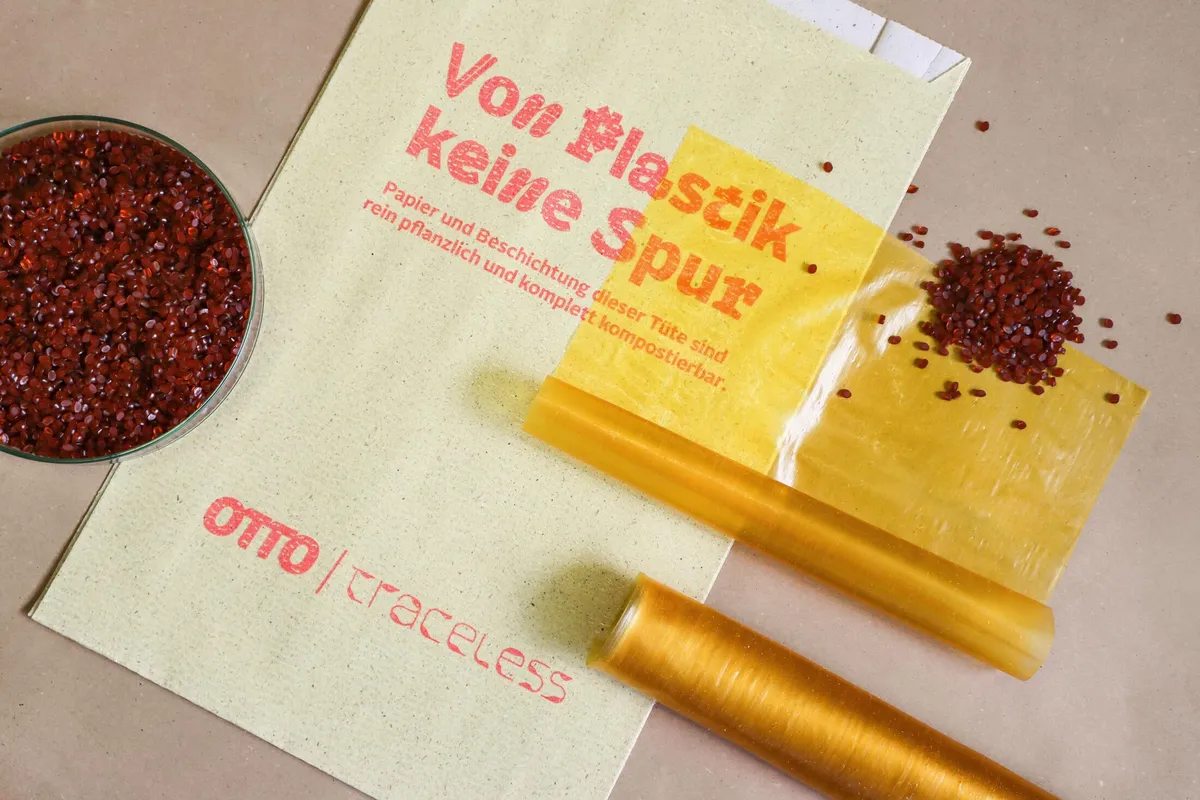

Together with Hamburg-based start-up traceless, OTTO is developing a mailing bag made entirely from plant-based materials that is fully compostable. A new prototype has been completed, initial tests showed promising results, but a large-scale live test has been postponed. OTTO packaging expert Karla Jabben and Anne Lamp, co-founder of traceless, explain why it will still take some time before the product is ready for market and why an adhesive, of all things, is causing the delay.
Karla, as a packaging expert on OTTO’s sustainability team, you are leading the collaboration with traceless. What is the current status?
KARLA JABBEN: We are making progress, but the development is more complex than expected. A larger pilot test was originally scheduled to start a few weeks ago, with a bag made from a composite of traceless material and grass paper. However, during an internal preliminary test, which we always conduct in projects like this, unexpected difficulties arose. That's why we decided to postpone the live test and invest more time in development.
ANNE LAMP: At traceless, we developed the plant-based coating material, but there’s more to it than that: coating, packaging, printing, folding, and gluing all have to work together. Our goal is for companies to be able to process our material on existing machines. This works, but not straight away, because the machines have been optimized for conventional plastics for decades. We also want to make sure that every processing step is truly sustainable. We found an environmentally friendly solution for printing, and folding worked as well, but the final step proved tricky: the gluing process. In the last prototype, this step was not yet ready for series production. Of course, it was disappointing that this meant we couldn't start the test phase.
New Prototype from traceless in Development
That sounds frustrating.
ANNE: Yes and no, because for me, the difficulty is also what makes it exciting: we are doing pioneering work together on this project and developing not just a mailing bag, but an entirely new type of plastic-free, plant-based material. As our very first partner, OTTO has been part of this exciting journey from the beginning. When we first met, we were still producing our materials in the lab – now, we have a team of thirty people, and our pilot plant is up and running. At the core of traceless is a process we developed to produce traceless granulate from plant residues. At the same time, we are working to optimize the material for different applications – the mailing bag is one of them.
What are possible solutions?
KARLA: For the bonding process, we found an environmentally friendly way to bond the traceless material – purely using heat, without any adhesives containing plastic. Unfortunately, there was no simple way to integrate the technology into our partner’s production line. Even for conventional bonding, the production line would have needed to be upgraded.
ANNE: From the very beginning, we discussed the idea of a bag made entirely from film with OTTO; at that time, we were not yet ready to move into series production. Since then, a lot has changed for us. This means we can now continue exploring the idea of the film bag – an option we find very exciting because it would give us a bag made entirely from traceless material. What’s more, the current mailing bags are already made of film, and the production equipment is designed for it.
Cooperation between OTTO and traceless Continues
What happens next?
ANNE: Together with partners, we will now test film production at different scales and gradually optimize the traceless material, including its further processing into mailing bags. In parallel, the current prototype made from coated paper remains an option that we are keeping in mind. We are therefore pursuing several solutions at the same time, which is always a strategic advantage in highly innovative projects. So it remains an exciting collaboration, with everything that comes with pioneering work: new terrain, exciting experiments, and great potential for innovative solutions!
There is no question of ending the collaboration between traceless and OTTO?
KARLA: No. Because we still firmly believe in traceless and in the potential to produce packaging from home-compostable and biodegradable materials in the future. With that in mind, we continue to work closely together.
Is it possible to say when traceless mailing bags will be used at OTTO? Or at least when a new test will take place?
ANNE: We aim to be ready for testing in 2024. The coming months are an exciting time for us because the OTTO project is part of scaling up our technology. We are currently planning a larger production facility for our material. This will enable us to process much larger quantities of plant residues in the long term and produce our traceless material from them.
The cooperation with traceless is just one of OTTO’s initiatives to make its shipping packaging more sustainable. You are also working with WILDPLASTIC. How is that progressing?
KARLA: Good! One in three OTTO mailing bags is already made from WILDPLASTIC material, and the share is increasing every month. By early summer, we will reach fifty percent and continue the transition. In parallel, since the start of the collaboration, we have also been able to stabilize the supply chains, thereby recovering increasing amounts of plastic from the environment. We want to expand the cooperation further and possibly extend it to other products.
FAQ
Questions & Answers. Straight to the point.
Frequently asked
The mailing bags used in the pilot test are made from grass paper and a bio-based material from traceless, produced from plant-based residues.
OTTO is developing the mailing bags together with Hamburg-based start-up traceless. The collaboration includes material development and tests under real shipping conditions.
Mailing bags need to protect products from damage and dirt. They also need to be opaque and tear-resistant. OTTO therefore tests new materials and prototypes under real shipping conditions
traceless produces its material from plant-based residues from the agricultural industry. The material is bio-based and has been used in the development of compostable packaging.
Press Contact